
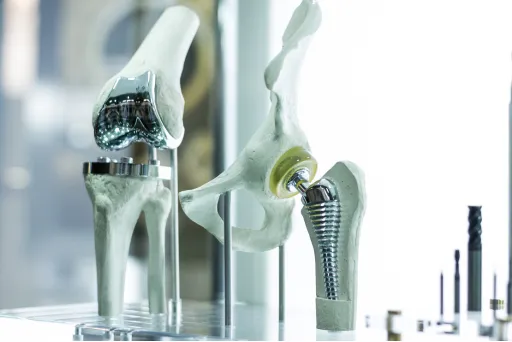
In medical manufacturing, materials and processes must deliver exceptional precision, cleanliness, and reliability under tightly controlled conditions.
Saint-Gobain supplies high-purity zirconia powders and grains used in casting, tooling, and processing equipment for medical components. These materials are not used directly in-body, but support the production of orthopedic implants, surgical instruments, and dental devices by enabling stable, inert, and repeatable processes.
Engineered zirconia’s thermal stability, chemical inertness, and controlled microstructure help reduce contamination risk and improve dimensional accuracy across critical steps such as investment casting, sintering, melting, and precision finishing.
Our consistent lot-to-lot quality and traceability help manufacturers meet stringent QA/RA expectations while maintaining throughput and yield.
Process Challenges in Medical Component Manufacturing
Biocompatibility & Cleanliness Constraints
Processes must minimize contamination risk and enable clean surfaces suitable for downstream sterilization.
Dimensional Precision at Temperature
Tools, molds, and linings must preserve geometry during thermal cycles to ensure tight tolerances.
Surface Integrity & Finish
Manufacturers require stable, inert interfaces that support smooth finishes and minimize post-processing.
Consistency & Traceability
Lot-to-lot uniformity and documented properties are essential for repeatable outcomes and compliance.
How Zirconia Supports Medical Manufacturing
High-purity zirconia provides a thermally stable, chemically inert platform for casting and processing equipment used to make medical components, helping preserve geometry, reduce reactions, and improve yield.
- Thermal Stability: Maintains strength and form through repeated heating/cooling cycles.
- Chemical Inertness: Minimizes reactions that could affect surface quality or cleanliness.
- Dimensional Control: Supports precise molds, crucibles, and fixtures for tight tolerances.
- Lot Consistency: Controlled particle size and phase content for predictable processing.
Applications in Medical Manufacturing
Our zirconia materials are applied in process equipment and tooling, not as in-body device materials, including:
Orthopedic Casting & Molds
Clean, inert mold media for precision casting of orthopedic and prosthetic components.
Surgical & Dental Tooling
Investment casting and sintering supports that enable high-strength, corrosion-resistant instruments.
Crucibles & Furnace Linings
Stable, contamination-resistant environments for melting and alloying medical-grade metals.
Analytical & Lab Ceramics
Fixtures and components that support precision R&D, metrology, and process validation.
These process-focused applications help manufacturers achieve cleaner surfaces, repeatable tolerances, and reliable throughput across regulated production environments.
Technical Snapshot of Zirconia for Medical Manufacturing
| Material Type | Typical Purity | Key Properties | Typical Use |
|---|---|---|---|
| Monoclinic Zirconia (≥ 99% ZrO₂) | High Purity, dense grain | High heat tolerance; inert; supports clean casting surfaces | Investment casting media; crucibles; precision fixtures |
| Stabilized Zirconia (CaO / Y₂O₃ / MgO) | Chemically stabilized | Thermal-shock resistance; phase stability; dimensional control | High-temperature tooling; furnace linings; sintering supports |
Impact and Value for Medical Manufacturers
By pairing high-purity feedstock with tight particle and phase control, our zirconia helps improve process reliability, reduce rework, and support documented quality plans in regulated environments.
Result: cleaner surfaces, tighter tolerances, and greater manufacturing confidence, without positioning our powders as in-body device materials.