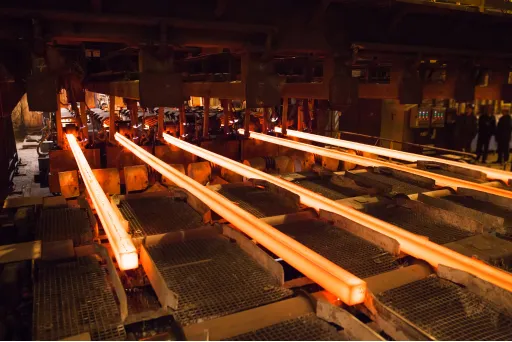
Continuous casting and secondary refining expose refractories to extreme mechanical, thermal, and chemical stresses. As steel quality requirements become more stringent, refractory performance directly impacts yield, cleanliness, and plant uptime.
Conventional alumina- or magnesia-based refractories degrade rapidly under these conditions, especially in contact with aggressive slags and high-temperature molten steel. This is where zirconia-based refractories deliver distinct advantages: high purity, exceptional corrosion resistance, and unmatched phase stability even beyond 2,000 °C.
Key Challenges in Steelmaking Refractories
Thermal Shock & Fatigue
Rapid temperature cycling during casting causes spalling and structural cracking, reducing component life.
Slag & Metal Corrosion
Reactive slags and molten steel dissolve refractory linings, increasing contamination risk and maintenance frequency.
Erosion & Clogging
High-velocity metal flow erodes nozzles and shrouds, leading to inconsistent steel flow and inclusion defects.
How Zirconia Improves Steelmaking Performance
Saint-Gobain’s fused and stabilized zirconia materials are engineered to withstand the harshest steelmaking environments. Their dense, crack-free microstructure and chemical inertness make them ideal for contact zones exposed to molten steel and slag.
- Superior Corrosion Resistance: Zirconia’s low wettability minimizes slag penetration and dissolution.
- Thermal & Phase Stability: Stable tetragonal and cubic phases maintain strength through extreme temperature gradients.
- Mechanical Integrity: High fracture toughness resists erosion and spalling under high flow velocities.
- Clean Steel Assurance: High-purity grains prevent contamination and inclusion formation during continuous casting.
Applications Across the Steelmaking Process
Zirconia-based refractories are integrated into several critical areas of the steelmaking process—particularly where high temperature, chemical attack, and mechanical wear coincide.
Slide Gate Plates
Provide precise flow control and superior erosion resistance under continuous operation.
Sub-Entry Nozzles (SENs)
Resist steel corrosion and clogging, ensuring smooth and stable casting flow.
Ladle Shrouds & Nozzles
Maintain steel purity and prevent oxidation during transfer between ladle and tundish.
Tundish Linings
Deliver slag corrosion resistance and temperature uniformity across casting streams.
Our zirconia materials have demonstrated 2-3× longer campaign life compared to traditional magnesia-alumina refractories in continuous casting operations, improving process reliability and reducing total cost of ownership.
Technical Snapshot of Recommended Zirconia Grades
The following zirconia grades are optimized for steelmaking refractories, providing the density, purity, and corrosion resistance required in molten-metal environments.
| Grade | Stabilizer | Key Performance Attributes | Primary Application |
|---|---|---|---|
| NSZ - Calcia Stabilized Zirconia | CaO | High density, crack-free grains with superior slag and metal resistance. | Continuous casting slide gates, nozzles. |
| CSZ – Calcia Stabilized Zirconia (Tilted Furnace) | CaO | Produced via tilted furnace for refined control of microstructure and purity, offering high thermal stability and slag resistance. | Steel-contact refractories, tundish linings, and high-temperature flow control parts. |
| FC-ZC (NSZ-C) | CaO | Ultra-pure, low black-point zirconia enhancing refractory cleanliness. | Clean-steel zones, submerged nozzles. |
| NSM – Magnesia Stabilized Zirconia (Higgins Furnace) | MgO | Higgins furnace process ensures fine grain uniformity and high corrosion resistance under thermal shock conditions. | Ladle linings, tundish impact zones, and wear-resistant refractory parts. |
| SGCM - Magnesia Stabilized Zirconia | MgO | Uniform stabilization and high corrosion resistance in slag contact areas. | Ladle linings, tundish impact zones. |